
Dutchess County Previous Residents by Era
A Dutchess County address can be followed through several layers, but each has a stated time range and a different kind of proof. The deed trail identifies legal transfers. Directories and census schedules add household clues. Tax rolls, maps, and aerial material help establish the parcel or structure’s setting. Start with the era most likely to contain the address, then use another source to test what the first record suggests.
| Source | Years It Covers | Where Held | What It Shows |
|---|---|---|---|
| Modern Dutchess deed search | 1989-present | County Clerk online and Record Room | Recorded land records, parties, dates, and document references |
| Deed images | From July 1907 | County Clerk online and Record Room | Transfer text, legal description, and prior-record references |
| Historical deed and mortgage index | 1718-1989 | County Clerk HistoricalSearch and Record Room | Party, year, liber, and page clues before modern access |
| Assessment and tax rolls | Historical municipal rolls 1952-2019 | County and municipal PDF pages | Owner or taxpayer, value, parcel, and roll-date context |
| Poughkeepsie directories | Verified rows from 1867-1868, 1871-1873, 1897, and 1928 | DCHS and PPLD Main & Market | Address, occupation, and household clues within city coverage |
| Howland Dutchess County Directory | 1895-1896 | DCHS Butts Research Library | Town and rural context beyond a city-only volume |
| Poughkeepsie Journal | 1785-present in the genealogy guide | Adriance microfilm, print, and online resources | Notices, obituaries, property activity, and address leads |
| Federal census | Released decennial schedules, through 1950 | NARA and library databases | Household composition and occupation, not a current-address source |
Online records are only one channel. The County Clerk Record Room can help with certified copies and pre-image material. Adriance and DCHS supply directories, newspapers, maps, and local-history support. Municipal assessors and collectors retain their own rolls. If an address has no online result, that is a reason to shift channels, not to invent a link between two people.
Resolving a Dutchess County Address
Use the county’s Address Info-Finder to resolve the structure first. It searches a structure address, not a mailing address, and can return the address, municipality, ZIP, and a report that links to ParcelAccess and district information. Its advanced fields are number, directional prefix, street, directional suffix, street type, and municipality. Try the municipal form and street suffix used locally when a postal rendering fails.
The next stop is ParcelAccess. Record the parcel number, associated grid numbers, parcel location, municipality, filed map or lot if shown, and assessment date. Its owner field and primary owner mailing address are tax information, not proof of who lived at the property. A parcel’s situs is its physical location; the mailing address may be elsewhere.
Note: Save the query date and the exact parcel label because assessments, districts, and displayed owner information can change between roll cycles.
Dutchess County Previous Residents in Deed Records
The Dutchess County Clerk Document Search is the legal ownership route. The form offers party-name fields, recorded-date limits, document year and number, liber and page, document type, and LP search. Results display party name, type, year, document number, liber, page, municipality, party type, recorded date, comment, and complement name. The current owner can be searched as a grantee or party after the parcel work identifies the correct property.
The County Clerk search interface provides the party, date, document, and liber/page fields used to begin an address trail.
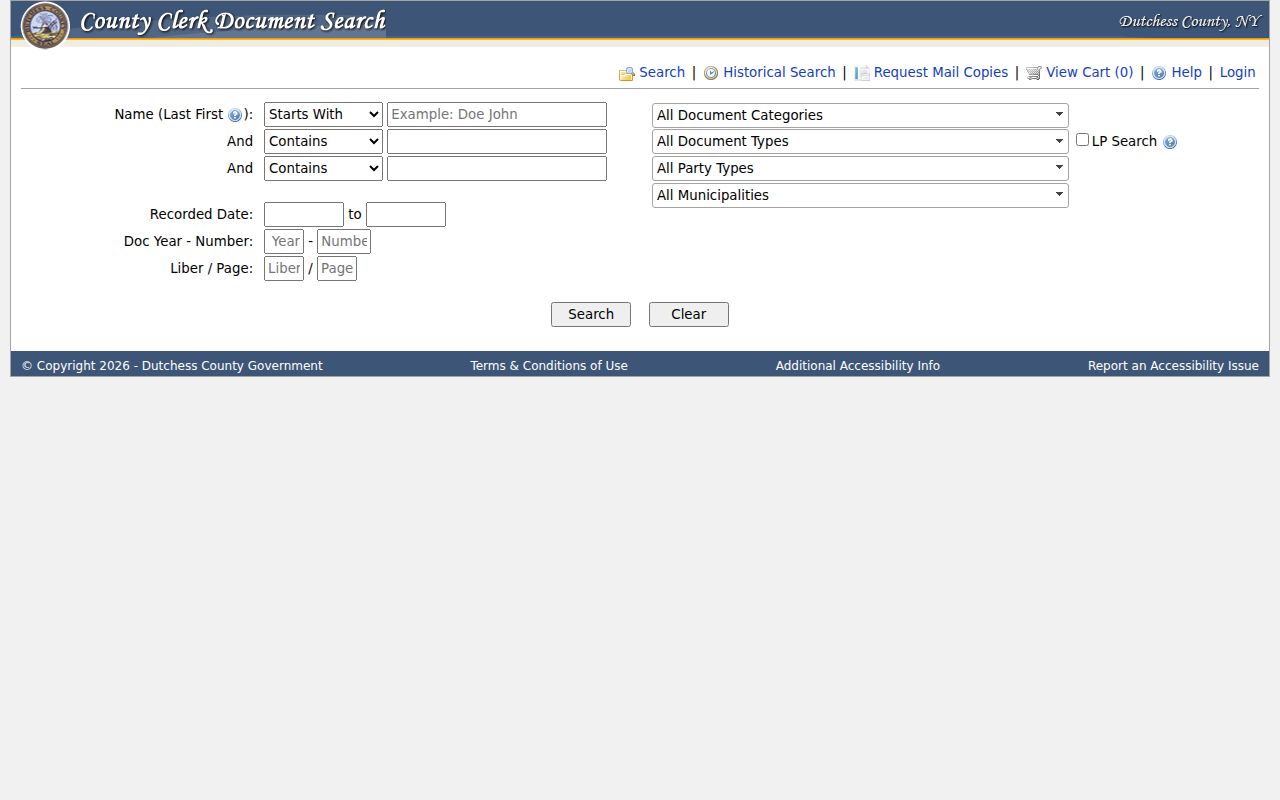
Party matching accepts all or part of a last-name-first entry and ignores punctuation, capitalization, and spaces. Even so, retain the exact printed form and try deliberate variants for names with Van, De, La, or apostrophe spacing. A land record may omit the street number, so the legal description, filed map, lot, and prior liber/page matter more than a modern street label.
Following Dutchess County Deed Chains
A chain of title is the sequence of legal transfers for the same parcel. It is not a list of every person who lived there. Start with the current assessed owner, find that person as a grantee in the document search, and use the deed image or a clerk copy to capture the party roles and legal description. Then search the seller from that deed as a grantee to find the seller’s earlier acquisition. Repeat the process only when the parcel description, lot, map, or prior instrument supports the match.
- Resolve the structure in Address Info-Finder and record the municipality, report, and linked parcel grid.
- Open ParcelAccess and save the assessed owner, parcel number, grid, legal map or lot reference, land use, and assessment date.
- Search the owner in the County Clerk index, then review the likely deed’s type, parties, recorded date, municipality, document number, liber, and page.
- Transcribe the grantor, grantee, legal description, prior-instrument reference, map or lot, and any address wording from the image or copy.
- Search that grantor as a grantee and repeat, returning to the deed chain when a mortgage or satisfaction appears.
- Grantor
- The party transferring an interest in the deed.
- Grantee
- The party receiving an interest in the deed.
- Chain of title
- The documented sequence of transfers for a parcel, tested with legal descriptions and record references.
- Legal description
- The deed’s formal parcel wording, such as a lot, filed map, or metes-and-bounds description, used to bridge changing address forms.
Dutchess County Previous Residents Before Online Images
Online viewing is free, but an unwatermarked download or print costs $0.50 per page. Certified copies come from the County Clerk Record Room. Modern land records are searchable from 1989, while older deeds have an image boundary in July 1907. The County landing page gives July 7, 1907; the historical search help gives July 23, 1907 and Liber 355. Treat that difference as a source boundary to verify at the Record Room, not as a detail to smooth over.
For an earlier transfer, use HistoricalSearch with party, year, liber, and page clues. The historical index reaches 1718-1989, but image availability varies. The fallback chain is the online historical index, then Record Room help or deed books and microfilm in person, with a mail request for a copy when appropriate.
Dutchess County Land Records by the Numbers
The County Clerk describes its public application as holding more than 1.3 million land and legal document images. The size of that collection explains why a name search can return several unrelated instruments. Narrow a result with its municipality, recorded date, document type, liber or page, and the parcel’s legal description. A large index is useful only when each hit is tied back to the right map, lot, and transfer.
Dutchess also preserves a much older legal layer. The Ancient Documents project has about 167,000 pages of surviving court filings from 1721 into the 1840s online, while the broader collection continues through 1889. Those pages can place a surname in county history, but a bond, warrant, or court role is not evidence of a modern street address or household.
Dutchess County Previous Residents in Directories
Ownership and occupancy are separate questions. A directory may place a household, a business, or an occupation at an address even when the deed names a different owner. The cataloged Poughkeepsie runs include Lant in 1867-1868, Vail in 1871-1873, LeRay in 1897, and Polk in 1928. Howland’s 1895-1896 county directory and the Breed railroad directory for 1899-1900 can help outside a narrow city search. The collections themselves and their catalog gaps are detailed in the Dutchess County City Directory.
Adriance Memorial Library keeps Genealogy and Local History rooms with newspapers, microfilm, an obituary index, church records, maps, census resources, and city directories.
Staff can answer focused telephone, mail, and email questions, but do not undertake in-depth research. Limit an obituary request to three. For newspaper searching, supply an exact date and page or a defined 14-day period. DCHS accepts research questions as well, which is useful for cataloged volumes, maps, and finding aids.
PPLD Main & Market is the online companion for digitized Poughkeepsie directories, yearbooks, photographs, portraits, groups, and local-resident material.
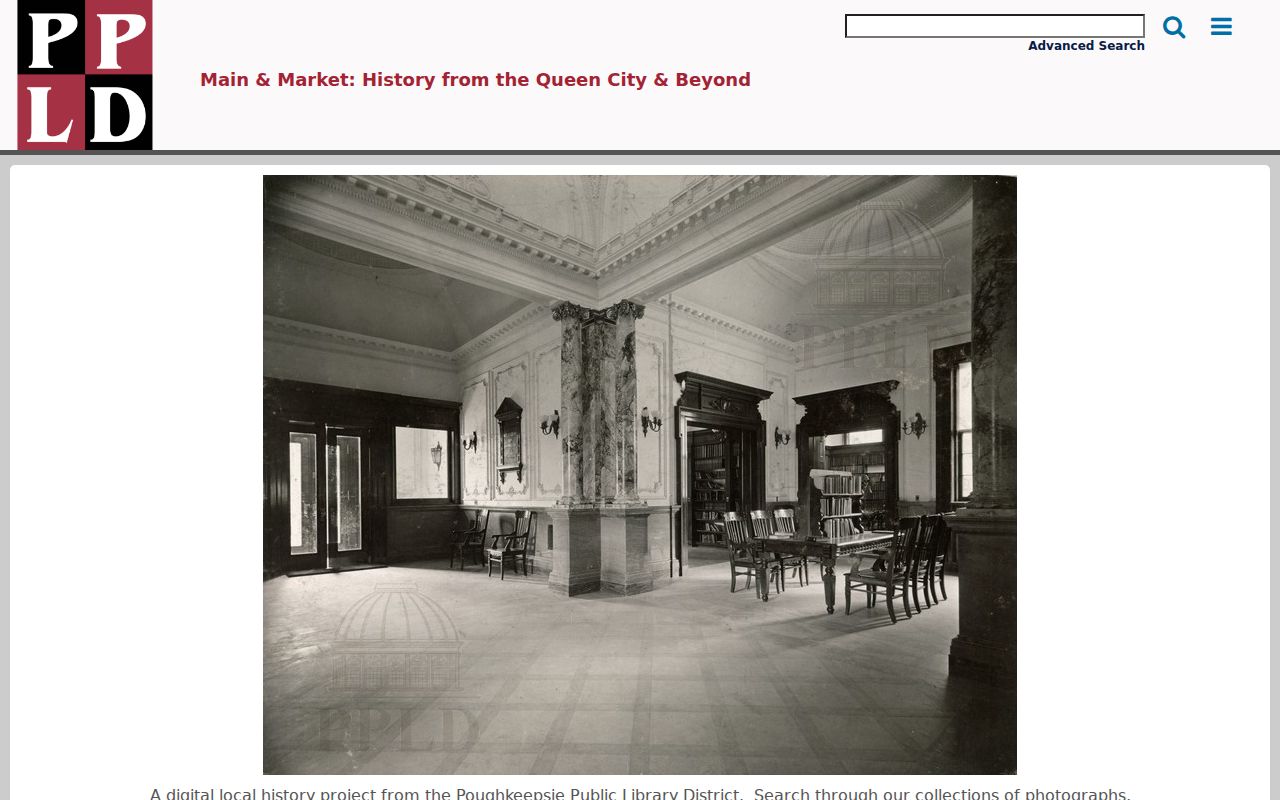
Read each digitized page image rather than trusting a search hit alone. Preserve the publication year, page, section, printed name, street wording, and any abbreviation key before linking it to a deed or census result.
Dutchess County Past Households and Census
Released federal census schedules can supply household composition and approximate ages, while a directory can supply an address and work clue closer to its publication date. The 72-year release rule means 1950 was the latest released federal census at the research date. Census address descriptions and geography may not match a modern municipal or postal label, so record the ward, town, or enumeration context exactly as shown.
- Place each verified directory listing on a timeline with its address, household wording, occupation, page, and publication year.
- Find the closest released census and compare names, approximate ages, household members, and the location description.
- Use the deed date and assessment or tax roll to separate a change in legal ownership from a household move.
- Check a newspaper, obituary, probate file, cemetery record, or church register when the final listing disappears.
These records can converge on a strong household history, but a directory absence, census omission, or tax mailing address should never be treated as proof that a person was not present.
Dutchess County Address Changes
Address continuity is the main trap in a Dutchess County house history. A city, town, village, hamlet, rural route, and postal label do not always share the same boundary. A legal parcel grid can remain steady while the postal city, ZIP, street suffix, or municipal rendering changes. Official research did not verify a countywide renumbering or readdressing chronology, so no single year should be assigned to explain an apparent mismatch.
Bridge an uncertain address with the legal description, old street name, adjacent owner, filed map, newspaper, municipality-specific clerk, and parcel grid. Historical municipal tax rolls cover 1952-2019, and the county tax-roll page is the route to those local materials. Poughkeepsie Sanborn material and Dutchess AerialAccess can date a building footprint or road pattern, but neither identifies every resident. The Sanborn set is limited to mapped built-up places, not every rural parcel.
Note: A structure shown on a map or aerial image existed by that source date, but the image does not establish who occupied it.
Dutchess County Previous Residents: Lawful Use
Past-resident research fits family history, estate or heir research, house history, consumer safety, and personal curiosity. Keep living people’s privacy in view. A tax mailing address, a parcel owner, a voter match, and a structure address are different facts. Confidential voter registration, the New York Address Confidentiality Program, and restricted records can cause intentional gaps or substituted addresses.
Lawful use. Use Dutchess County previous-resident records for responsible historical or personal research. Do not use a result to stalk, harass, or harm any person.
New York FOIL is a route for reasonably described existing agency records, not a way to bypass confidentiality or force an agency to create a missing address history. For a municipal permit or code record with no countywide portal, contact the responsible city or town office and make a narrow request by address, document type, and date range.