
Finding Dutchess County Residents
No single official list covers every Dutchess County resident at every address. So the right record depends on the question. For a current property connection, begin with the county map and assessment records. For a known registered voter, the state lookup form fits. Older households are often documented better elsewhere. A printed directory, newspaper, census entry, church record, or deed may say more about a past family than any modern portal, and each source has its own keeper, date range, and limits.
Match the record to the detail in hand. An address belongs in the GIS tools. A full name with date details suits the voter form. A grantor or grantee name fits the Clerk's document search. And for an old Poughkeepsie household, library and historical-society shelves may beat any online search. Treat each match as a lead until an independent record supports it.
- Resolve an address in the county tool and save its municipality and parcel grid.
- Use ParcelAccess for the assessed owner, situs, mailing address, and assessment cycle.
- Check the County Clerk index for deeds and related recorded documents.
- For a known voter, use the New York lookup with the required identity fields.
- Use a local clerk, library, counter, or focused FOIL request when the record is not online.
Note: An owner, a tax recipient, and a current occupant can be three different people, so each lookup needs a source-specific reading.
Dutchess County Resident Records Offices
Poughkeepsie serves as the county-seat hub for land, court, history, and local-reference records. The County Clerk records land documents, court filings, naturalizations, and maps, and takes document-search applications. Parcel tools come from the Real Property Tax Service Agency. Municipal assessors build the local rolls. The Board of Elections handles registration matters. City and town clerks matter when an event or permit belongs to one municipality.
Dutchess County Clerk
22 Market Street
Poughkeepsie, NY 12601
845-486-2120
Real Property Tax Service Agency
Countywide parcel access
Poughkeepsie, NY
ParcelAccess public portal
Dutchess County Board of Elections
112 Delafield Street
Poughkeepsie, NY 12601
845-486-2473
For certified copies and questions a web result cannot answer, the Clerk's Record Room is still the route. Confirm its current counter location before visiting. The Clerk posted a temporary relocation notice in January 2026.
Dutchess County ParcelAccess Records
The free Dutchess ParcelAccess map is the strongest starting point for a current address. Its parcel modes include Parcel Lot, Owner Name, and Address. Address search offers Number, Predir, Street, Postdir, Suffix, and Municipality fields. The parcel card lists a parcel number and grids. It also lists location and municipality. Owner name, mailing address, lot size, land use, assessment, market value, and school district can appear too. Read it as property evidence. It is not a current household roll for Dutchess County.
| ParcelAccess field | How to read it |
|---|---|
| Parcel location | The situs, or physical location, which can differ from postal wording. |
| Owner name | The assessed owner on the roll, not proof of present occupancy. |
| Mailing address | The tax-correspondence destination, which can be elsewhere. |
| Grid and municipality | Details for connecting maps, filed lots, and recorded documents. |
When ParcelAccess rejects a postal version of an address, open the Address Info-Finder first. It is a structure-address tool. Its report links to ParcelAccess plus school, election, legislative, and emergency-service layers. For parcel work itself, the county's ParcelAccess search is the main entry point.
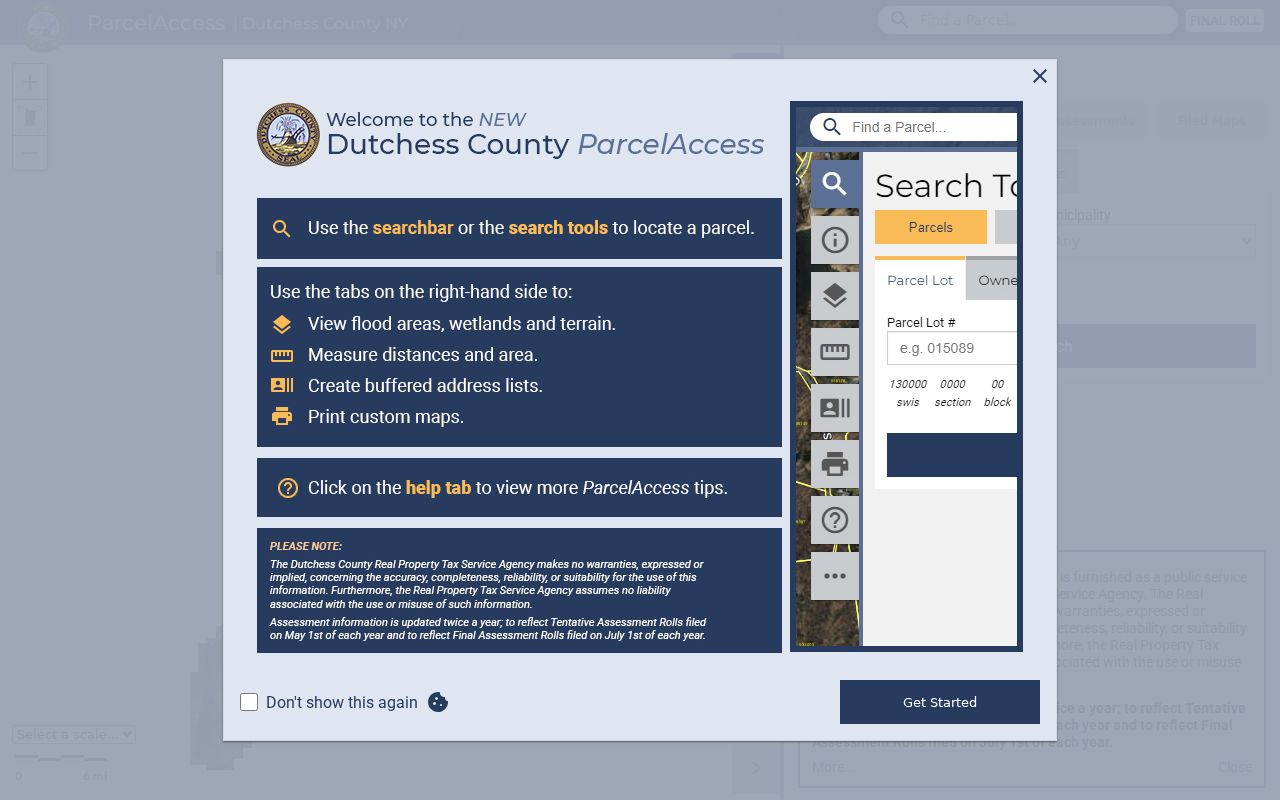
The tabbed search form shows why an address query needs a municipality. A returned parcel is a starting point, not a complete resident list.
Dutchess County Address Reports
The Dutchess Address Info-Finder does not search a mailing address. It resolves a structure location through number, directional, street, suffix, and municipality fields. Results can include the address, municipality, ZIP, and a report link. That report opens ParcelAccess plus district and emergency-service detail. The split matters when a tax mailing address points elsewhere. It also matters when the postal service renders a street differently.
If a query misses, the county offers a missing-address form. It asks for street address, municipality, name, and email. That form only routes the question. It proves nothing about an occupant. Save the mapped parcel grid and municipality. Then move to the deed index or a municipal office. Start with the county address tool itself.
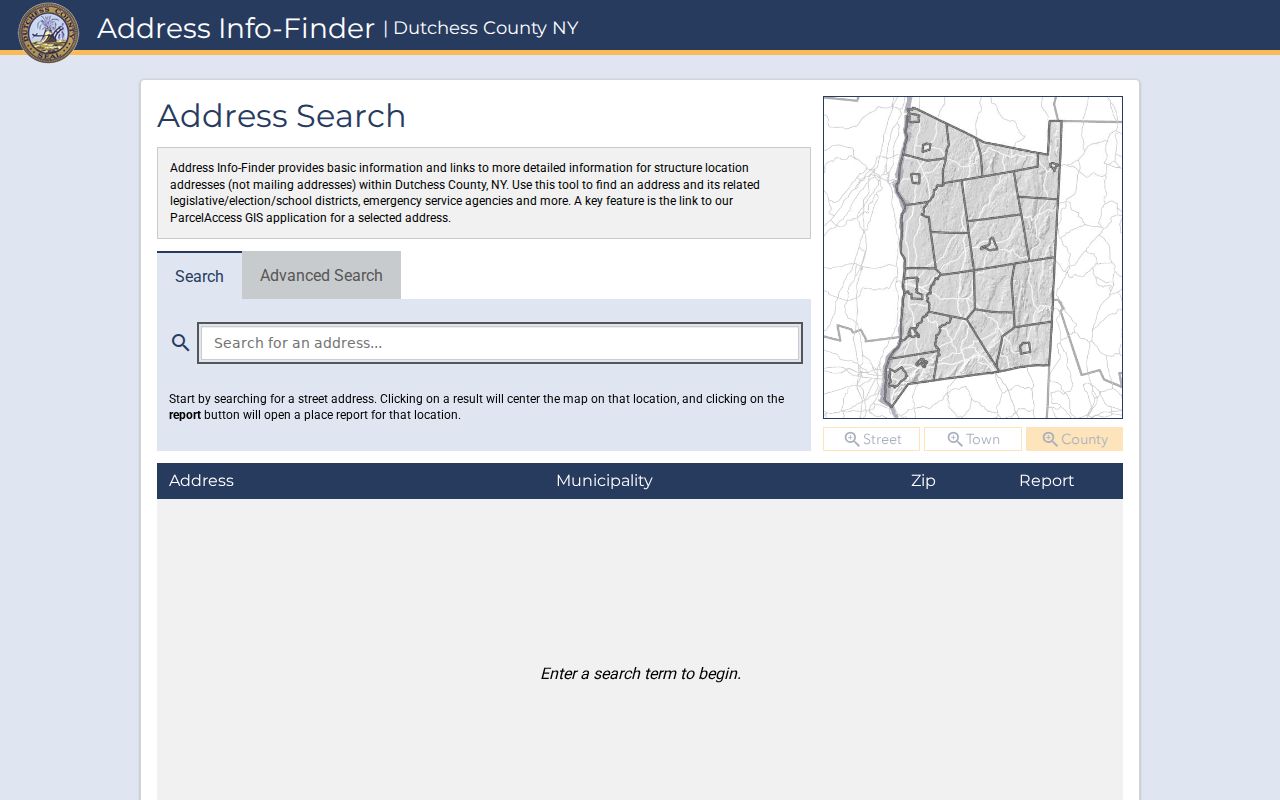
The structure-first form shows why a modern postal label is not the only version of a Dutchess County address. Older records and county systems may name the same street differently.
Dutchess County Voter Lookup Details
The New York State Voter Lookup matches a known registered voter to a poll site. It asks for county, last name, first name, date of birth, and ZIP or address context. A non-match proves nothing about registration. A spelling difference, an address change, inactive status, timing, or a confidential registration can all explain it. The public form is not a downloadable roster. It supplies no household list for Dutchess County.
| Input | Format or role | Practical limit |
|---|---|---|
| County | Select Dutchess | Separates the search from statewide name matches. |
| Last and first name | Registered name | Use the name carried on the registration. |
| Date of birth | MM/DD/YYYY | A search credential, not data to publish. |
| ZIP context | Registration ZIP | Postal geography is not a municipal boundary. |
The state election records-request route requires an elections-purpose statement for voter-registration data under Election Law §3-103(5). Registrations kept confidential under Election Law §5-508 stay outside ordinary inspection. The official voter form displays the fields used for a targeted match.
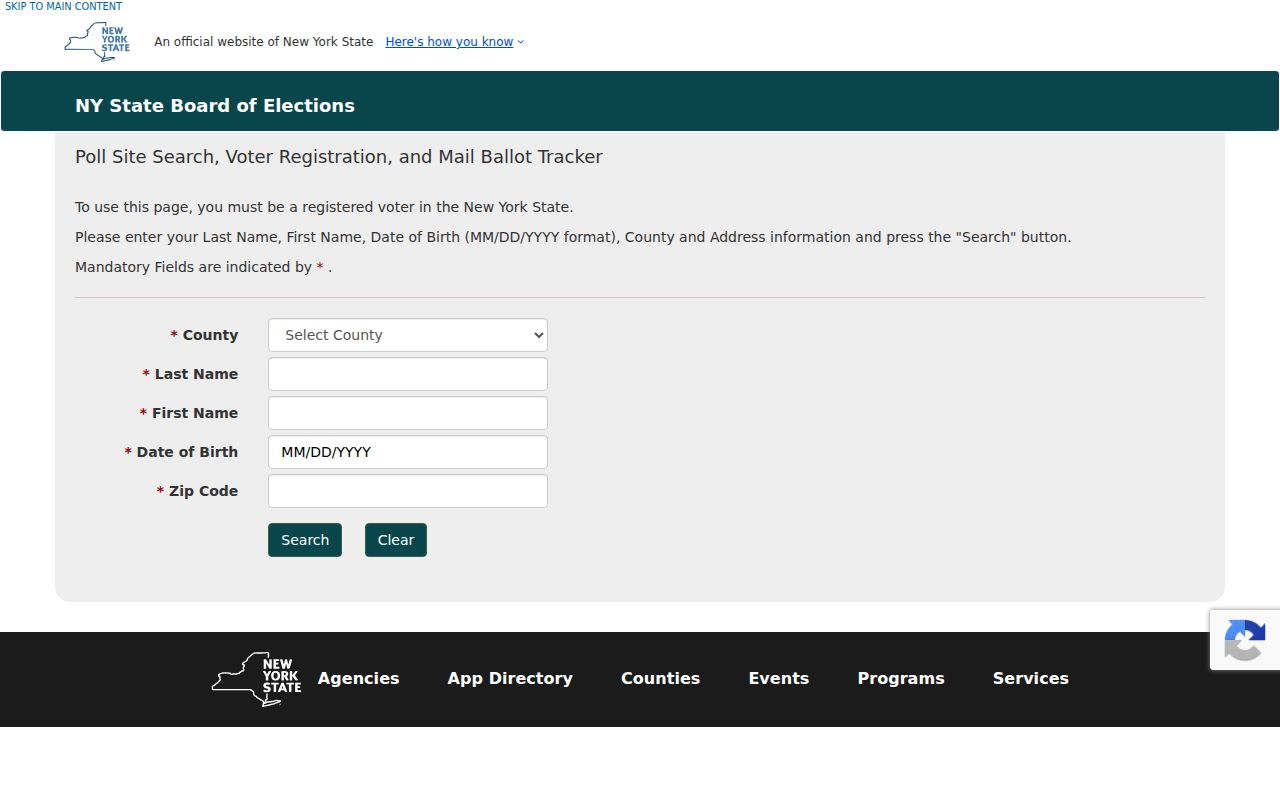
Pair a voter result with an address or parcel record only when the lawful purpose fits. The source's limits must match the question too.
Dutchess County Deed Index Trail
Deed research in Dutchess County starts with the County Clerk Document Search. It ties names to recorded land and legal papers. The form is flexible. It accepts up to three name criteria plus date ranges. You can also search by document year and number, liber and page, and document type. Party-name searches take full or partial names. The Clerk notes that punctuation, capitalization, and spaces are ignored. This smooths out Van, De, La, and apostrophe variants. Even so, keep the spelling exactly as printed on the record.
A result can carry party name, type, year, and document number. It also lists liber, page, municipality, party type, recorded date, comment, and complement name. Viewing images is free. Unwatermarked downloads or prints cost $0.50 per page. Certified copies come through the Record Room. Modern deeds run from 1989. Older deed images begin in the 1907 layer. The historical index reaches back to 1718. Pre-modern work may call for the historical interface or counter help from the records office.
- Grantor
- The party transferring an interest in a recorded document.
- Grantee
- The party receiving that interest, useful for moving backward through title.
- Liber and page
- The book and page reference used to locate older recorded material.
- Parcel grid
- A county identifier that helps distinguish similar addresses and names.
View the Dutchess County document search used for this residents directory record trail.
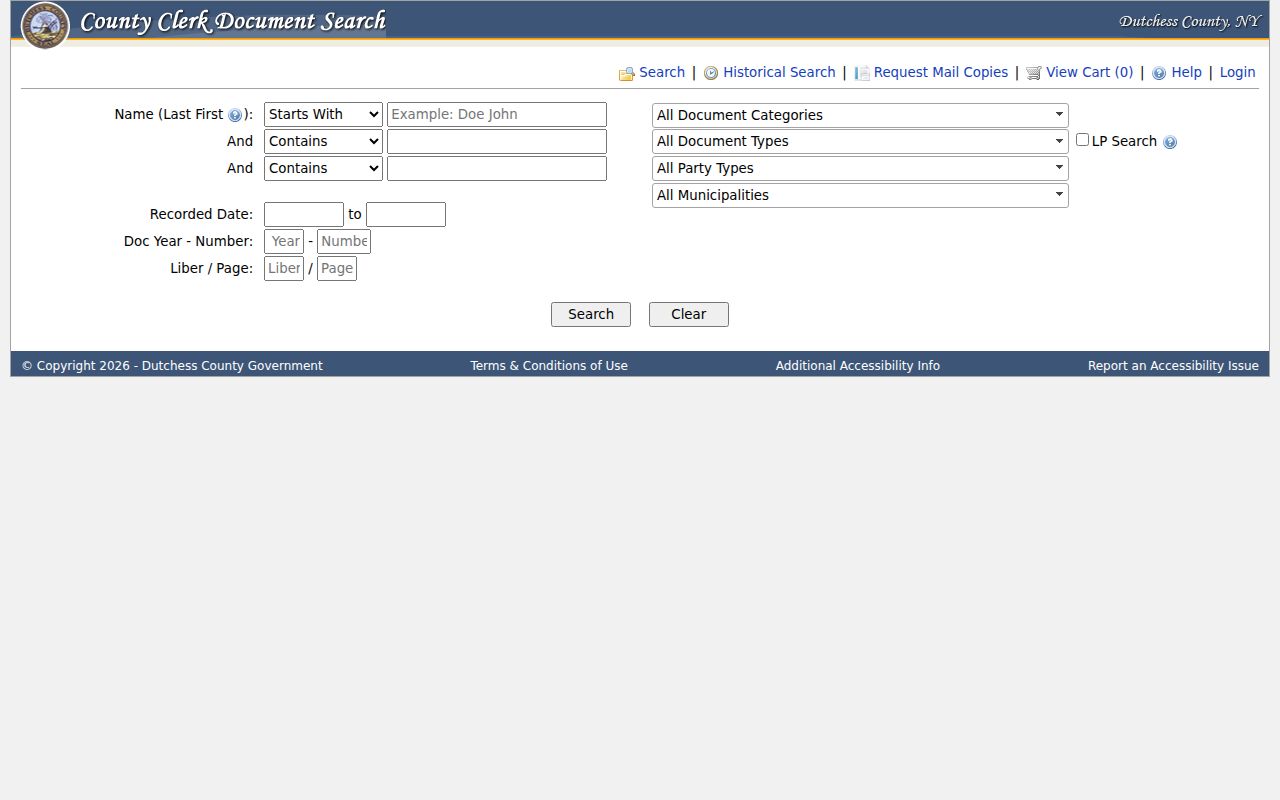
The search form displays party, date, document, and liber/page fields. Those filters narrow a recorded-document lead before any copy is requested.
Current Dutchess County Resident Directories
No single source lists everyone now living in the county. Current Dutchess County resident evidence is scattered across narrow tools. ParcelAccess works best for assessed ownership. The state voter form covers one registered voter at a time. The County Clerk index surfaces people named in land or legal records. Each source states what it actually measures. None of them builds a complete current residents directory roster.
| Record source | What it can confirm | Custodian | Access path |
|---|---|---|---|
| ParcelAccess and rolls | Assessed owner, parcel, and tax mailing detail | County tax agency and assessors | Free map and municipal roll PDFs |
| Voter match | A targeted voter and poll-site context | NYS and Dutchess elections | Known-person form; protected records excluded |
| Recorded index | Parties to deeds, mortgages, liens, and filings | Dutchess County Clerk | Free view; copies by stated channel |
| Municipal clerk records | Locally created permit or vital leads | Responsible city, town, or village | Clerk, form, mail, or FOIL route |
A name needing careful confirmation belongs on the Dutchess County resident lookup path. There, court, vital, and privacy limits stay separate from address research.
Verifying Dutchess County Record Matches
A solid Dutchess County residents directory result is a convergence. One name hit is never enough. Cross an address or parcel grid with a municipality. Add a date. Add a spouse or occupation from an older source. Then find an independent record. Dutchess complicates this. Dutch, Palatine German, New England, and other naming histories produce variants. These show up in spaces, initials, given names, and married names. County Clerk matching ignores formatting, while newspaper OCR or a library index may not.
For a present property question, set the parcel card beside the recorded deed. For a historic household, pair a directory entry with a census lead. A newspaper, church, or cemetery lead works too. Court captions need the court, case type, date, party role, and file itself. A shared surname never proves a family tie on its own. The same goes for a mailing address or business address. It proves no current residence either.
Use public Dutchess County records for lawful personal research and civic purposes only. Never use a record trail to stalk, harass, impersonate, or harm another person.
Dutchess County Court and Vital Limits
New York eCourts and NYSCEF can supply selected case information. The clerk keeps the official file. WebCivil searches run by index number, party name, attorney, judge, or calendar. A civil result may show a case number, caption, court, case type, and status. It can also list appearance details, judge, and available documents. Sealed matters, youthful-offender records, adoption files, and many Family Court details stay closed. Some Article 81 material stays closed to the normal search path, too.
Vital records take a different route entirely. Local registrars and clerks hold local events or licenses. The New York State Department of Health holds statewide records outside New York City. Genealogy access opens after 75 years for births when the person is known deceased. For deaths and qualifying marriages, it opens after 50 years. The State Archives microfiche is an index resource rather than a certificate office. FOIL cannot override these confidentiality rules.
Note: A clerk, registrar, or court counter can explain access and copies. Only the responsible custodian supplies the official record.
Historical Dutchess County Directories
For past residents of Dutchess County, the local historical shelf beats any single database. The Dutchess County Historical Society locator points to specific directory titles and shelf information. Poughkeepsie Public Library District's Main & Market offers digitized city directories. It also holds yearbooks, portraits, photographs, and local-resident material. Catalog rows confirm Poughkeepsie directories for 1867-68, 1871-73, 1897, and 1928. A Howland Dutchess County Directory covers 1895-96, and a Hudson River Railroad directory spans 1899-1900.
An entry can place a name at an address. It may add occupation, spouse, or household clues. It cannot prove ownership by itself or reach every town. City books are strongest inside their stated locality. Rural research usually needs a county directory, tax map, church or cemetery record, and municipal history. The full collection route sits on the Dutchess County city directory page.
Dutchess County Ancient Papers Online
Dutchess carries an unusually deep historical layer. The County Clerk's Ancient Documents project holds roughly 167,000 pages of surviving legal papers from 1721 into the 1840s. The MacCracken Index bridges names to the 1721-1800 material. These are not old address books. A person may surface as a debtor, creditor, or witness. A person may also appear as an administrator, attorney, defendant, officer, or party to a bond or warrant.
The project suits a name, locality, year, record type, or document-number question. Caution still applies. A portal date can describe a filing rather than the event behind it. Search the index first, then inspect the image or ask the County Clerk or History Department about a non-digitized item. That survival story explains why Dutchess history resists any reduction to a modern address search.
Dutchess County Request Fallbacks
A portal cannot answer every narrow question. That is when the holding office matters. The County Clerk works through counter visits, phone calls, mail, document images, and certified copies. A city or town clerk may hold the proper municipal record. A county system does not always have it. Adriance Memorial Library staff take focused questions but not broad projects. So give an exact newspaper date, page, or a tight 14-day window for an obituary request.
New York's Freedom of Information Law sits in Public Officers Law Article 6. Its chief sections are §§87 and 89. Describe existing records reasonably, name the custodian, and add a time range or address. State your format. Agencies will not build a new list or chase another office's file. Exemptions survive too, including records shielded by separate confidentiality statutes. The New York election records request instructions show one focused route. It is not a general people search.
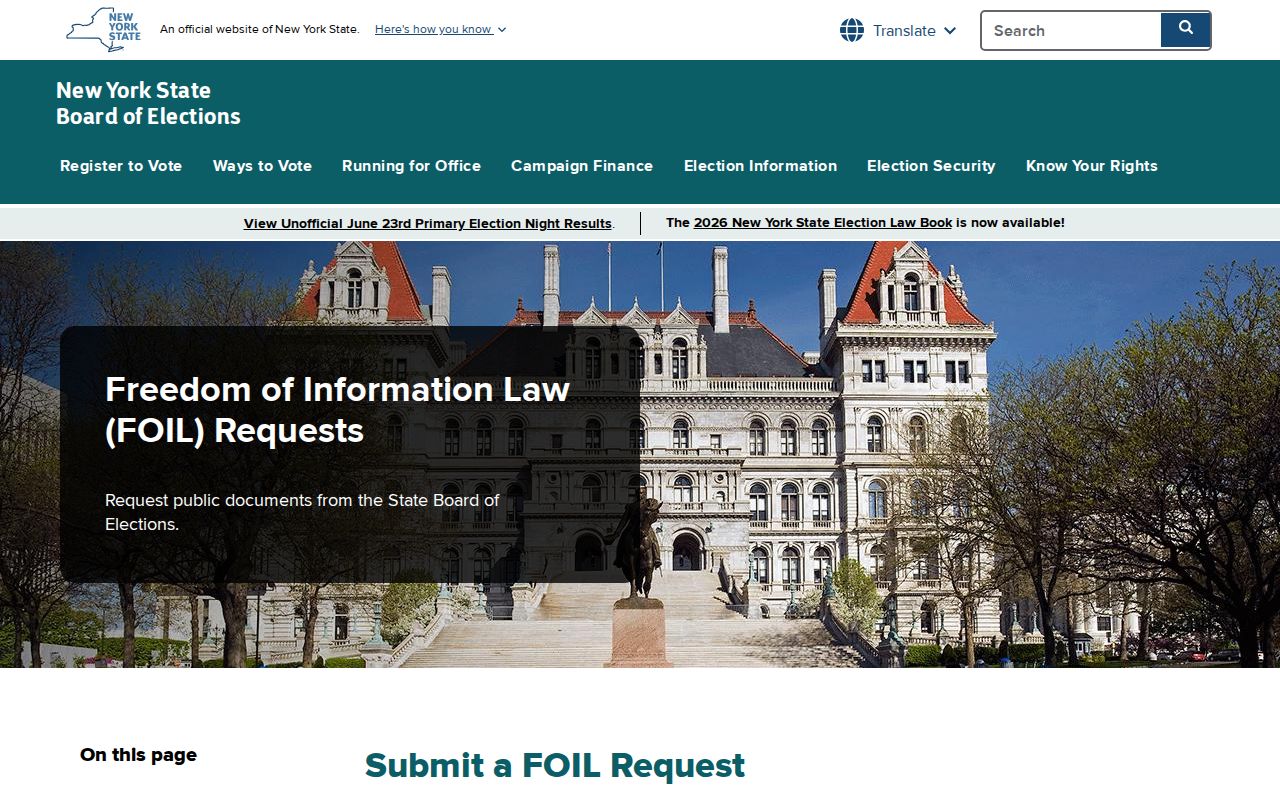
That request guidance carries a reminder of its own. Voter data operates under a use statement and confidentiality rules, even while much of the rest of the county's record base stays public.
Dutchess County Municipal Records Layer
County records never replace a city or town office. Beacon's City Clerk collects local records, licenses, vital-record applications, and FOIL channels, while its Building Department forms point to address-specific permit and code categories. Poughkeepsie's Clerk and Chamberlain office keeps local vital and city records. It reported finishing a nearly three-year digitization effort in May 2026, spanning close to 150 years of community history. Eligibility and record type still govern access. Visit the Beacon City Clerk page for the municipal source displayed there.
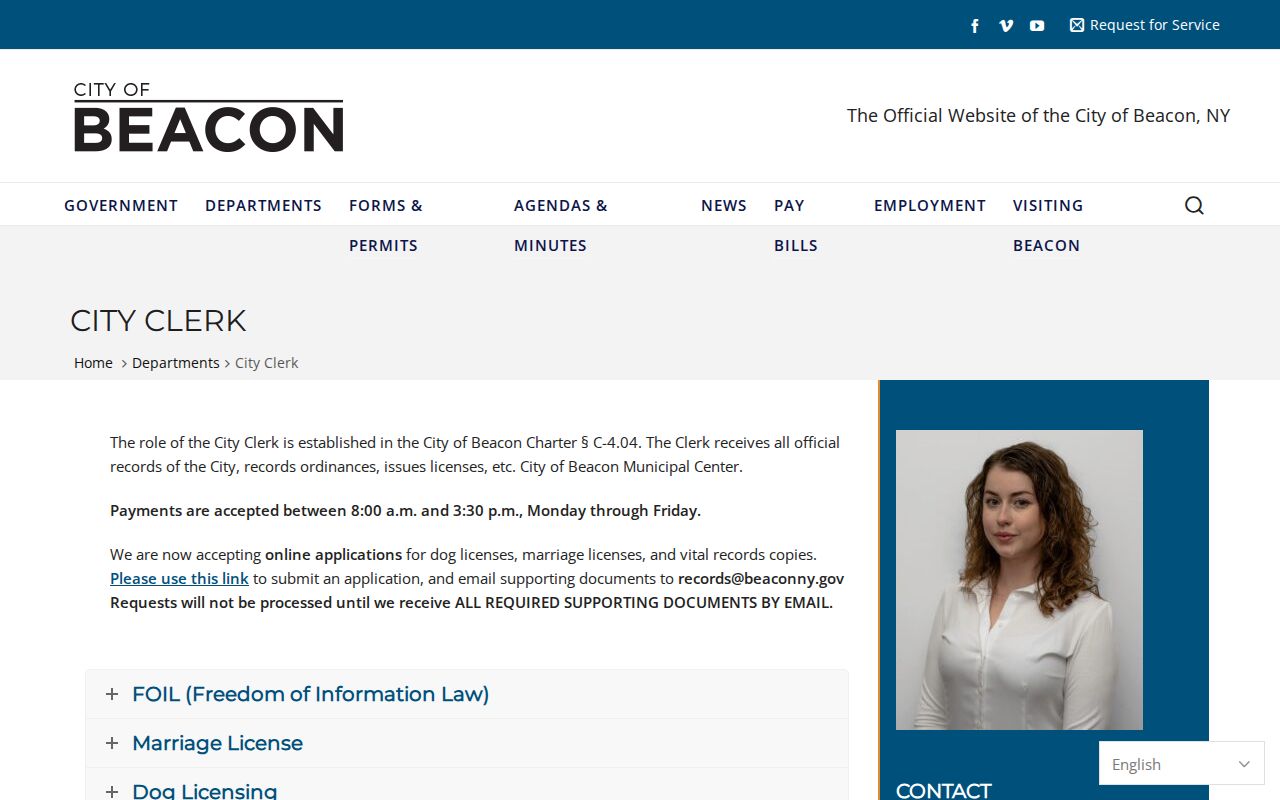
Treat that municipal page as a routing point for one local request. It is not a countywide directory or a public list of every license holder.
Dutchess County Deed Watch Safety
Recorded-document activity can protect consumers too. The County Clerk launched free Dutchess Deed Watch in January 2025. Enroll up to four full names. Get email alerts when deed or mortgage documents are recorded. It is a notification tool only. It is not a title opinion, not a substitute for searching the index, and not a way to fix a recording.
The county had also warned residents about a private deed-copy solicitation asking for $86. Compare any unexpected letter with the Clerk's published routes and fees. Type the official address yourself instead of clicking a mailer's link. Ask the Clerk whether a named document exists. Viewing the official source is free, and its stated copy channels carry defined costs. Open the official Dutchess Deed Watch signup from the Clerk.
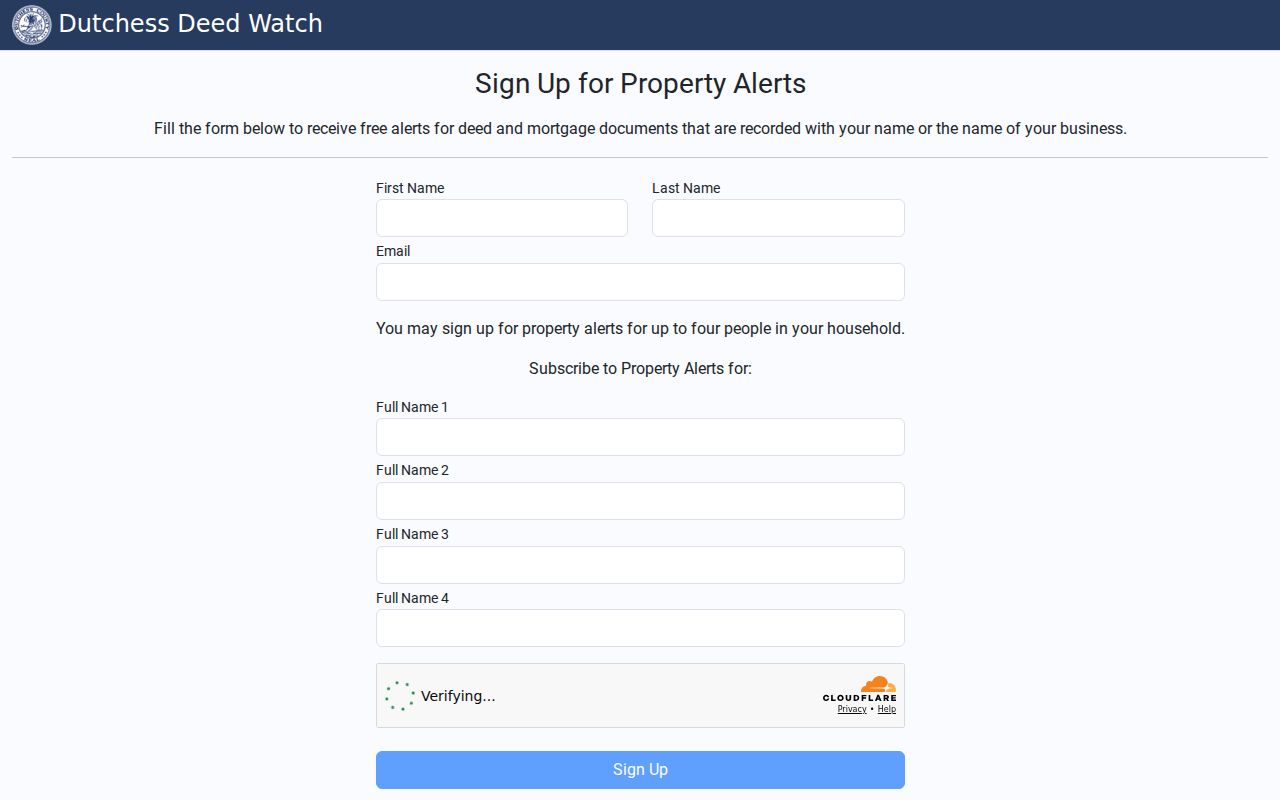
The form covers a limited alert enrollment only. Use it alongside the Clerk's recorded-document index, never in place of it.
Dutchess County Records Work in Layers
Dutchess County keeps its records in layers. The layers include river cities, towns, villages, hamlets, courts, municipal clerks, state agencies, library shelves, and GIS. Poughkeepsie and Beacon hold dense directory, newspaper, court, and map material. In eastern or rural stretches, a parcel grid, tax map, church or cemetery record, county directory, and local clerk can beat a city directory. Postal labels add yet another wrinkle, since a ZIP code does not define a municipal boundary.
Start from your strongest identifier and work outward. A verified address leads to a parcel grid. The parcel leads to a deed, and the deed date points to a tax roll or directory. An older household opens the door to a census or newspaper. Write down each source, date, municipality, and limit as you go. A careful trail beats a quick, unsupported name match every time.