
Dutchess County City Directory Collections
The strongest starting point is the Dutchess County Historical Society Butts Research Library locator. It identifies individual directory rows by title, publisher, date, call number, town history, subject, and access status. That detail matters. The catalog confirms selected volumes, not an uninterrupted series, so a missing year should be treated as a gap to investigate. Poughkeepsie volumes form the core of the cataloged city material, while the Howland county book reaches beyond a city-only search.
| Collection | Years | Where Held | Access |
|---|---|---|---|
| Lant Poughkeepsie directories | 1867-1868 | DCHS Butts Research Library | Physical volume or focused staff lookup |
| Vail Poughkeepsie volume | 1871-1872 and 1872-1873 | DCHS Butts Research Library | Publisher-specific volumes |
| R. V. LeRay Poughkeepsie volume | 1897, catalog note tied to 1896 | DCHS Butts Research Library | Verify the title page before citing |
| Polk Poughkeepsie volume | 1928 | DCHS, shelf F:127:D8 | Inspect the printed volume and its key |
| Howland Dutchess County Directory | 1895-1896 | DCHS Butts Research Library | County and rural-town context |
| Breed New York City & Hudson River Railroad directory | 1899-1900 | DCHS Butts Research Library | River and railroad-corridor context |
| Poughkeepsie digital directory collection | Varies by digitized item | PPLD Main & Market | Online images, inspect each item |
The library locator makes it possible to search by a town, title, date, or the word “directory.” It is also the safer way to find a lesser-known county run because it prevents a researcher from assuming that every town had the same years of coverage. A city directory is evidence for the publisher’s stated geography and date, not for all of Dutchess County.
Note: Keep the catalog title, publication year, shelf information, and page citation together so the same result can be checked later.
Dutchess County Directory Years on the Shelf
The cataloged dates tell a local story of uneven but useful coverage. Lant supplies an early Poughkeepsie point in 1867-1868. Vail follows in 1871-1873. The LeRay row is for 1897, although its catalog notation is tied to 1896, and the Polk volume is dated 1928. These are separate records with different publishers and shelf information. Read each title page before treating a catalog date as the printing date.
For a search outside Poughkeepsie, the Howland Dutchess County Directory for 1895-1896 may be more useful than a city book. The Breed railroad directory from 1899-1900 adds another layer for river towns and rail-linked businesses. Neither is a complete county household roll. Their value is in matching a name, place, and period with an independent source such as a deed, tax roll, church register, or newspaper.
Dutchess County City Directory at Main & Market
PPLD Main & Market is the Poughkeepsie Public Library District’s digital local-history collection. Alongside the Poughkeepsie historical volumes, it includes photographs, postcards, yearbooks, portraits, groups, social clubs, historic documents, and local-resident images. Search results are a lead, not a substitute for examining the scanned page, because text recognition is not guaranteed for every item.
The Main & Market digital-collections page shows the online collection categories that can accompany a search of the historical volumes.
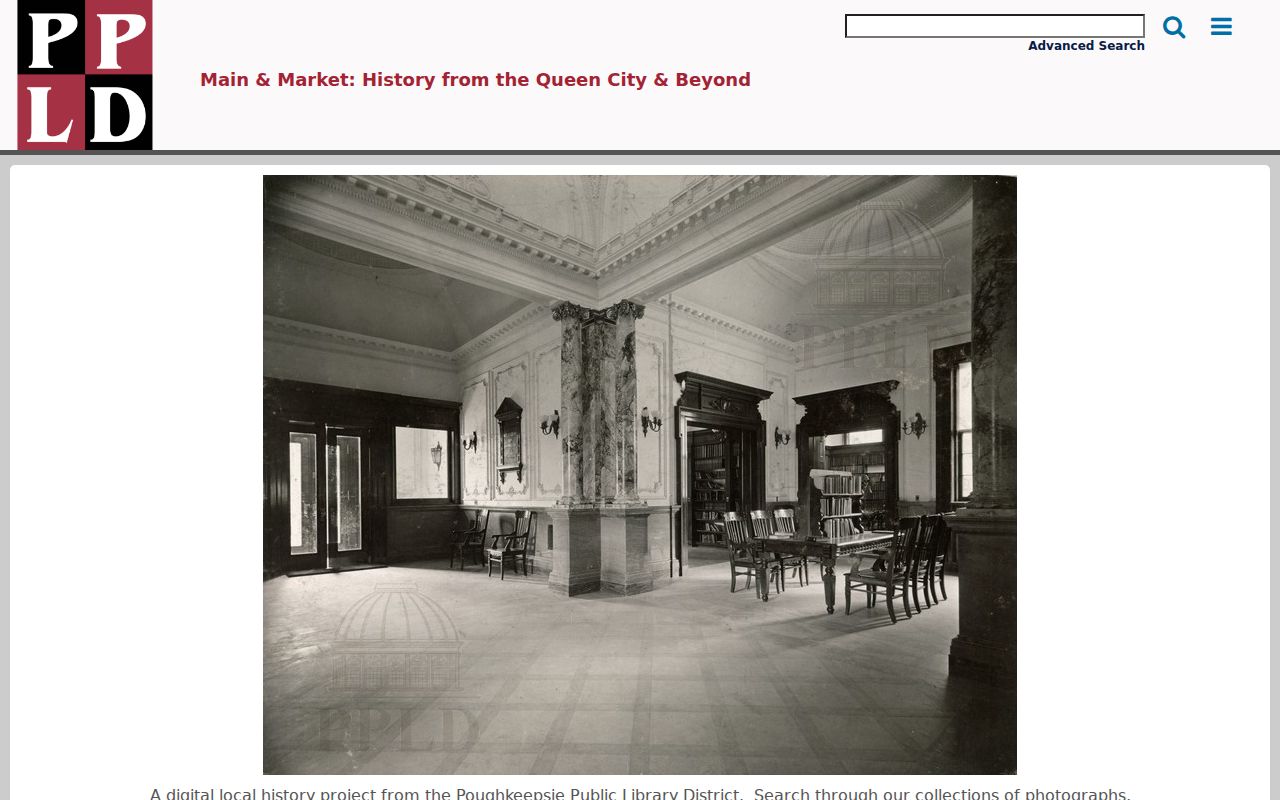
Use a digital image to capture the printed spelling, year, page, and any section heading. A yearbook portrait or a group listing can support identity work, but it does not replace the address and occupation details in a directory entry.
Reading a Dutchess County City Directory Entry
Start by photographing or transcribing the title page, publication year, and abbreviation key. Then read the alphabetic name section and, if the volume has one, the street or address section. A person may appear under an abbreviated given name, a spouse or household notation, or an occupation. A business address can differ from a residence. Do not silently modernize a surname, especially where a newspaper index or later database may handle spacing differently.
| Printed name | Record surname, given name, initials, and spelling exactly as displayed. |
|---|---|
| Household notation | Note a spouse, widow, or other household wording only when the entry prints it. |
| Occupation or employer | Useful for separating people with the same name and for locating a business listing. |
| Street and number | Capture the residence or business address and preserve the entry’s street form. |
| Publisher and page | These make the finding checkable when another volume uses a similar name. |
- Criss-cross directory
- An address-ordered section, when a volume includes one, used to look from a street toward listed occupants or businesses.
- Householder index
- An index arranged around the person or household named by the publisher, not a guarantee that every person at the address appears.
- Abbreviation key
- The volume’s own explanation of shorthand. Confirm each mark from that key instead of importing a meaning from another directory.
A change in a widow notation, work description, or address can guide the next search. It cannot by itself prove a death, marriage, sale, or continuous residence.
Dutchess County Directory Research Rooms
Adriance Memorial Library’s Genealogy and Local History rooms are on the main floor at 93 Market Street in Poughkeepsie. The library lists Monday through Thursday hours of 9:00 a.m. to 8:30 p.m., Friday and Saturday hours of 9:00 a.m. to 5:00 p.m., and Sunday hours of 2:00 p.m. to 5:00 p.m., except for its listed summer closure. Its local-history collection includes newspapers, microfilm, an obituary index, church records, maps, census resources, local organizations, and city directories.
The Adriance local-history page is the source for current research-room information and focused-request contacts.
Staff answer focused telephone, mail, and email questions, but do not promise open-ended research. Give a full name, a narrow date range, and a specific page, obituary, or title request. The library limits obituary requests to three and asks for an exact date or page, or a 14-day window, for newspaper work.
Dutchess County City Directories Beyond Poughkeepsie
The Dutchess County Historical Society holds more than one shelf of directory-related material. Its research tools index points to the library locator, finding aids, yearbooks, gravestone transcriptions, and digital bookshelf links. DCHS collections are at 6282 Route 9 in Rhinebeck. The society’s materials provide local-history context and are not the same thing as county government land or court records.
The DCHS locator displays the directory shelf information needed to select a volume before a visit or a targeted question.
DCHS accepts research questions through its online process. Its research guidance cautions that volunteer or genealogy help may not add to what is already in online databases unless donated family material is involved. Ask for a named volume or limited fact instead of a broad family-history search.
Dutchess County Names Before Directories
For an earlier surname, the County Clerk’s Ancient Documents viewer is a different kind of historical trail. The project places about 167,000 pages of surviving Common Pleas and General Sessions papers online, with material dating from 1721 into the 1840s within the online project and a broader surviving collection through 1889. A name may appear as a debtor, creditor, attorney, witness, officer, or party in a bond or warrant, not as a resident at a modern street address.
The MacCracken Index, created by Henry Noble MacCracken in 1954-1955, indexes 1721-1800 records and offers a practical bridge before browsing document images. Search by name, year, location, document type, or document number. The document date is the creation date and may not be the date of the event described.
Dutchess County City Directories in a Household Trail
Trace a household across several nearby directory years rather than treating one listing as final. A person can disappear because a volume skipped a year, the family moved beyond its geographic reach, a publisher changed territory, or an abbreviated name was used. Pair each directory year with a released census year. The census can identify household members and approximate ages, while a directory may offer a more precise street address and an occupation.
- Search the DCHS locator and Main & Market for the nearest known year, name, address, school, church, or occupation.
- Record the printed name, household wording, work detail, street number, street name, town or ward, volume year, and page.
- Check two or three adjacent directory years and label a missing listing as “not listed” rather than automatically treating it as a move.
- Compare the sequence with released federal or state census material, keeping the census geography separate from the city directory’s coverage.
- Use a deed, tax roll, newspaper, obituary, probate file, or cemetery record to test the final appearance.
When the goal shifts to a current parcel and its legal record chain, use the modern address tools on the Dutchess County Street Directory rather than treating an old directory listing as current occupancy.
Note: A directory and a census can reinforce a household timeline, but neither source proves uninterrupted residence between its stated dates.
Dutchess County Directory Gaps and Newspapers
The Dutchess County genealogy guide lists the Poughkeepsie Journal from 1785 to the present and can lead to obituaries, legal notices, marriage announcements, property activity, club meetings, and business advertisements. Adriance offers print, microfilm, and online resources as available. A tight request, such as an exact date and page or a 14-day window, gives staff a realistic newspaper target.
For a missing directory year, look first for the nearest verified catalog row and then for a newspaper, yearbook, church record, tax roll, or census schedule that matches the place. River-side Poughkeepsie and Beacon have denser directory and map material than many eastern towns. The Library of Congress Poughkeepsie Sanborn set has 100 sheets, dated 1913 and republished 1952, for Poughkeepsie and nearby mapped places. It can test whether a building or street number existed, but it is not a countywide household roster. Rural research often needs the county directory, church or cemetery records, tax maps, and parcel grids together.
Dutchess County Directory Access Channels
Online access begins with Main & Market, the DCHS locator, the County Clerk’s historical viewers, and released census resources. In person, use Adriance for newspapers, microfilm, and local-history holdings; DCHS in Rhinebeck for cataloged collections; and the County Clerk Record Room or History Department when a legal or government record is needed. The DCHS research information explains its request route and limits.
Phone, email, and mail requests work best when the request identifies a name, a short date range, and a desired record. Adriance lists localhistory@poklib.org and 845-485-3445 ext. 3350. The Dutchess History Department lists WTatum@DutchessNY.gov and 845-486-2381. Some volumes remain undigitized, and complete current household rosters, sealed records, and unindexed rural residents are not substitutes for responsible archival research.